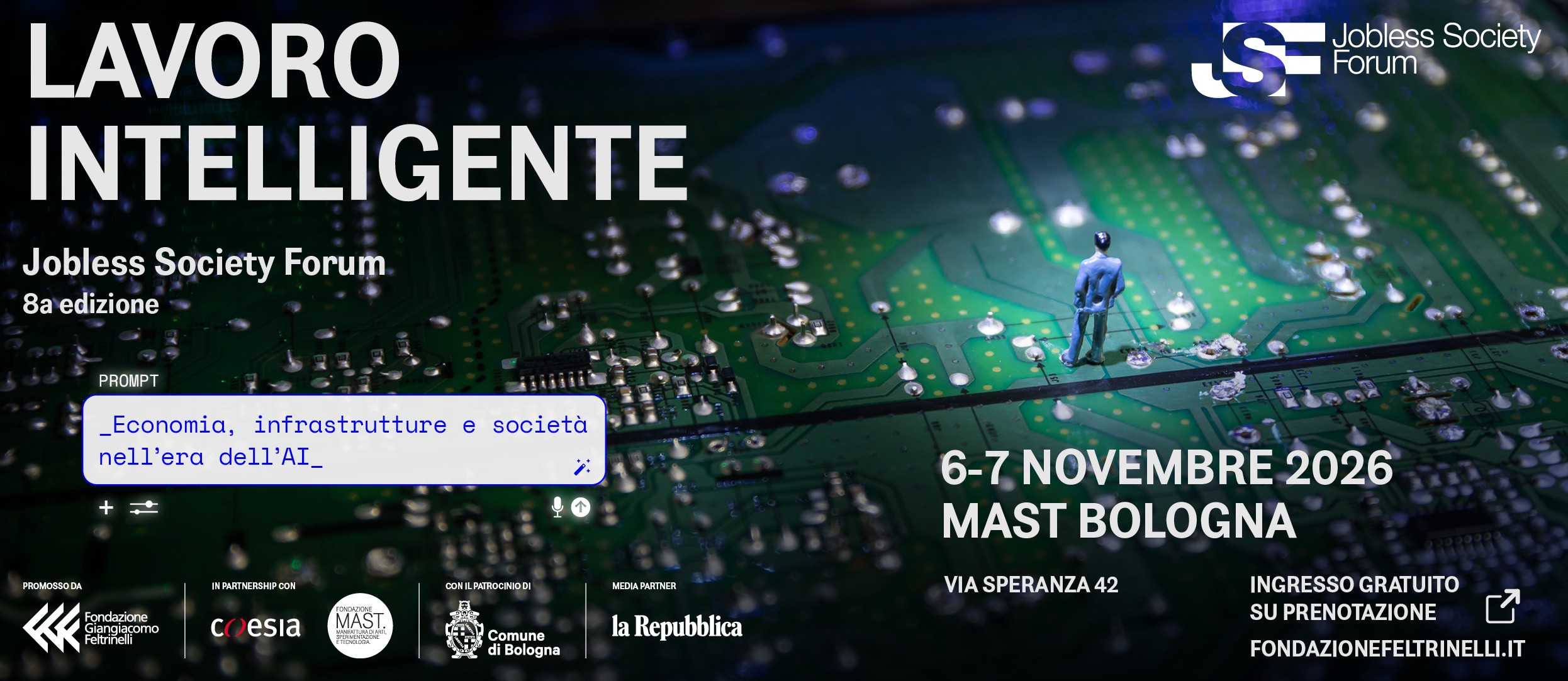
Il 7 novembre ero a Bologna, come uditore, all’ottava edizione del Jobless Society Forum, promosso dalla Fondazione Giangiacomo Feltrinelli con Coesia e Fondazione MAST. Il titolo, «Lavoro intelligente», è un’ambiguità felice: è il lavoro a diventare intelligente, o è l’intelligenza a mettersi al lavoro?
Mi è tornata in mente una pagina della Politica. Aristotele immagina strumenti che lavorano da sé, come le statue di Dedalo e i tripodi di Efesto, e ne trae una conclusione che oggi suona quasi profetica:
εἰ γὰρ ἠδύνατο ἕκαστον τῶν ὀργάνων κελευσθὲν ἢ προαισθανόμενον ἀποτελεῖν τὸ αὑτοῦ ἔργον, […] οὕτως αἱ κερκίδες ἐκέρκιζον αὐταὶ καὶ τὰ πλῆκτρα ἐκιθάριζεν, οὐδὲν ἂν ἔδει οὔτε τοῖς ἀρχιτέκτοσιν ὑπηρετῶν οὔτε τοῖς δεσπόταις δούλων.
Se ogni strumento sapesse compiere da sé il suo lavoro, su comando o anticipandolo, […] se le spole tessessero da sole e i plettri suonassero da soli la cetra, i capi artigiani non avrebbero bisogno di aiutanti, né i padroni di schiavi.
Aristotele, Politica I 4, 1253b33–1254a1 (parafrasi; cfr. trad. it. di R. Laurenti, Laterza).
Ventiquattro secoli dopo, la spola tesse da sola. Ma al forum la storia non sembrava andare come Aristotele l’aveva immaginata.
Fra le molte voci, alcune mi hanno interrogato più di altre. Le dispongo lungo tre fili.
Il primo è il potere calcolato visto da chi lo subisce. Valentina Mira, autrice di Tutto il furore (Feltrinelli), romanzo corale sul lavoro precario, ha raccontato fra l’altro di un magazzino della logistica in cui l’algoritmo di gestione era come Dio: nessuno lo conosceva, ma tutti sapevano di dovergli obbedire. Roberto Ciccarelli ha ricordato il caso di Parcoursup, la piattaforma con cui dal 2018 la Francia decide dove gli studenti possono iscriversi all’università, da anni discussa per l’opacità dei suoi criteri.
Il secondo filo è il linguaggio, e ciò che resta all’umano. Ariel Pennisi (Università di Buenos Aires), che con Miguel Benasayag ha scritto ChatGPT non pensa (e il cervello neppure), ha ripreso l’idea che il linguaggio chieda un corpo e un territorio, e ha evocato vettori che colonizzano il vivente come nei sistemi biologici. Mira ha accennato a una parte irriducibile della lingua, qualcosa come un’anima in senso junghiano. Il neuroscienziato Torkel Klingberg (Karolinska Institutet), autore di un libro che si chiede perché imparare se le macchine sanno già tutto, ha portato la questione sulla scuola e sull’apprendimento.
Il terzo filo è quello delle istituzioni e della geopolitica. Cosimo Accoto ha parlato dell’IA come di una terraformazione, una trasformazione che chiede istituzioni nuove, e ha richiamato un’immagine cara ai suoi libri, la coevoluzione fra specie: mutualismo, parassitismo, competizione, predazione, e solo la prima giova a entrambe. Achille Mbembe ha ripreso alcuni temi del suo lavoro, dal «divenire-negro del mondo» al brutalismo, fino all’idea di un’intelligenza democratica che tenga insieme le forze della vita. Jingwei Alex He (HKUST) ha raccontato come la Cina sperimenti l’intelligenza artificiale territorio per territorio, e in un passaggio ha condensato la geografia del settore in una battuta: gli Stati Uniti innovano, la Cina applica, l’Europa regola.
Voci diverse, spesso in tensione fra loro. Viste da qui, mi sembrano girare intorno a una stessa domanda.
Che cosa accade a chi lavora quando lo strumento non si limita più a fare il lavoro, ma comincia a misurarlo?
È la domanda del logos calcolato. Nei prossimi Confronti tornerò sulle relazioni che più hanno catturato la mia attenzione (attention is all you need).
La posta, intanto, è alta. Il lavoro non è un tema fra gli altri. Per Hegel è lavorando, dando forma alla cosa, che il servo giunge alla coscienza di sé: nel lavoro l’uomo si riconosce. Il Novecento ne ha fatto un campo di contesa decisivo, dall’Operaio di Jünger alla distinzione di Hannah Arendt fra lavoro, opera e azione. Se oggi una parte di quel lavoro passa alle macchine, la domanda non è soltanto quanti posti si perderanno. È più radicale: il lavoro esce dal campo del propriamente umano? E se sì, dove torneremo a riconoscerci?
Nota di riflessione a partire dalla partecipazione come uditore. Le affermazioni dei relatori sono riportate dai miei appunti presi in sala; le interpretazioni sono mie. Riferimento: Jobless Society Forum — MAST ↗.
On 7 November I was in Bologna, as an audience member, at the eighth Jobless Society Forum, promoted by Fondazione Giangiacomo Feltrinelli with Coesia and Fondazione MAST. Its title, “Intelligent Work”, is a happy ambiguity: is work becoming intelligent, or is intelligence being put to work?
A page of the Politics came back to mind. Aristotle imagines tools that work by themselves, like the statues of Daedalus and the tripods of Hephaestus, and draws a conclusion that sounds almost prophetic today:
εἰ γὰρ ἠδύνατο ἕκαστον τῶν ὀργάνων κελευσθὲν ἢ προαισθανόμενον ἀποτελεῖν τὸ αὑτοῦ ἔργον, […] οὕτως αἱ κερκίδες ἐκέρκιζον αὐταὶ καὶ τὰ πλῆκτρα ἐκιθάριζεν, οὐδὲν ἂν ἔδει οὔτε τοῖς ἀρχιτέκτοσιν ὑπηρετῶν οὔτε τοῖς δεσπόταις δούλων.
If every tool could do its own work, on command or anticipating it, […] if shuttles wove by themselves and plectra played the lyre on their own, master craftsmen would need no assistants, and masters no slaves.
Aristotle, Politics I 4, 1253b33–1254a1 (paraphrase; cf. the translation by B. Jowett).
Twenty-four centuries later, the shuttle weaves by itself. Yet at the forum the story did not seem to be unfolding as Aristotle had imagined.
Among the many voices, some questioned me more than others. I lay them out along three threads.
The first is calculated power as seen by those subjected to it. Valentina Mira, author of Tutto il furore (Feltrinelli), a choral novel about precarious work, spoke among other things of a logistics warehouse where the management algorithm was like God: nobody knew it, yet everyone knew they had to obey it. Roberto Ciccarelli recalled the case of Parcoursup, the platform through which France has decided since 2018 where students may enrol at university, debated for years for the opacity of its criteria.
The second thread is language, and what remains to the human. Ariel Pennisi (University of Buenos Aires), who wrote La inteligencia artificial no piensa (el cerebro tampoco) with Miguel Benasayag, took up the idea that language requires a body and a territory, and evoked vectors that colonise the living as in biological systems. Mira hinted at an irreducible part of language, something like a soul in the Jungian sense. The neuroscientist Torkel Klingberg (Karolinska Institutet), author of a book asking why we should learn if machines already know everything, brought the question to school and learning.
The third thread is that of institutions and geopolitics. Cosimo Accoto spoke of AI as a terraforming, a transformation that calls for new institutions, and recalled an image dear to his books, coevolution between species: mutualism, parasitism, competition, predation, and only the first benefits both. Achille Mbembe returned to some themes of his work, from the “becoming-Black of the world” to brutalism, up to the idea of a democratic intelligence that holds together the forces of life. Jingwei Alex He (HKUST) described how China experiments with artificial intelligence territory by territory, and at one point condensed the geography of the field into a quip: the United States innovates, China applies, Europe regulates.
Different voices, often in tension with one another. Seen from here, they seem to circle the same question.
What happens to those who work when the tool no longer merely does the work, but begins to measure it?
It is the question of Calculated Logos. In the coming Dialogues I will return to the talks that most caught my attention (attention is all you need).
The stakes, meanwhile, are high. Work is not one topic among others. For Hegel it is by working, by giving form to the thing, that the servant comes to self-consciousness: in work the human being recognises itself. The twentieth century made it a decisive field of contention, from Jünger’s Worker to Hannah Arendt’s distinction between labour, work and action. If part of that work now passes to machines, the question is not only how many jobs will be lost. It is more radical: is work leaving the realm of what is properly human? And if so, where will we recognise ourselves again?
A reflection prompted by attendance as an audience member. The speakers’ statements are reported from my notes taken in the room; the interpretations are my own. Reference: Jobless Society Forum — MAST ↗.