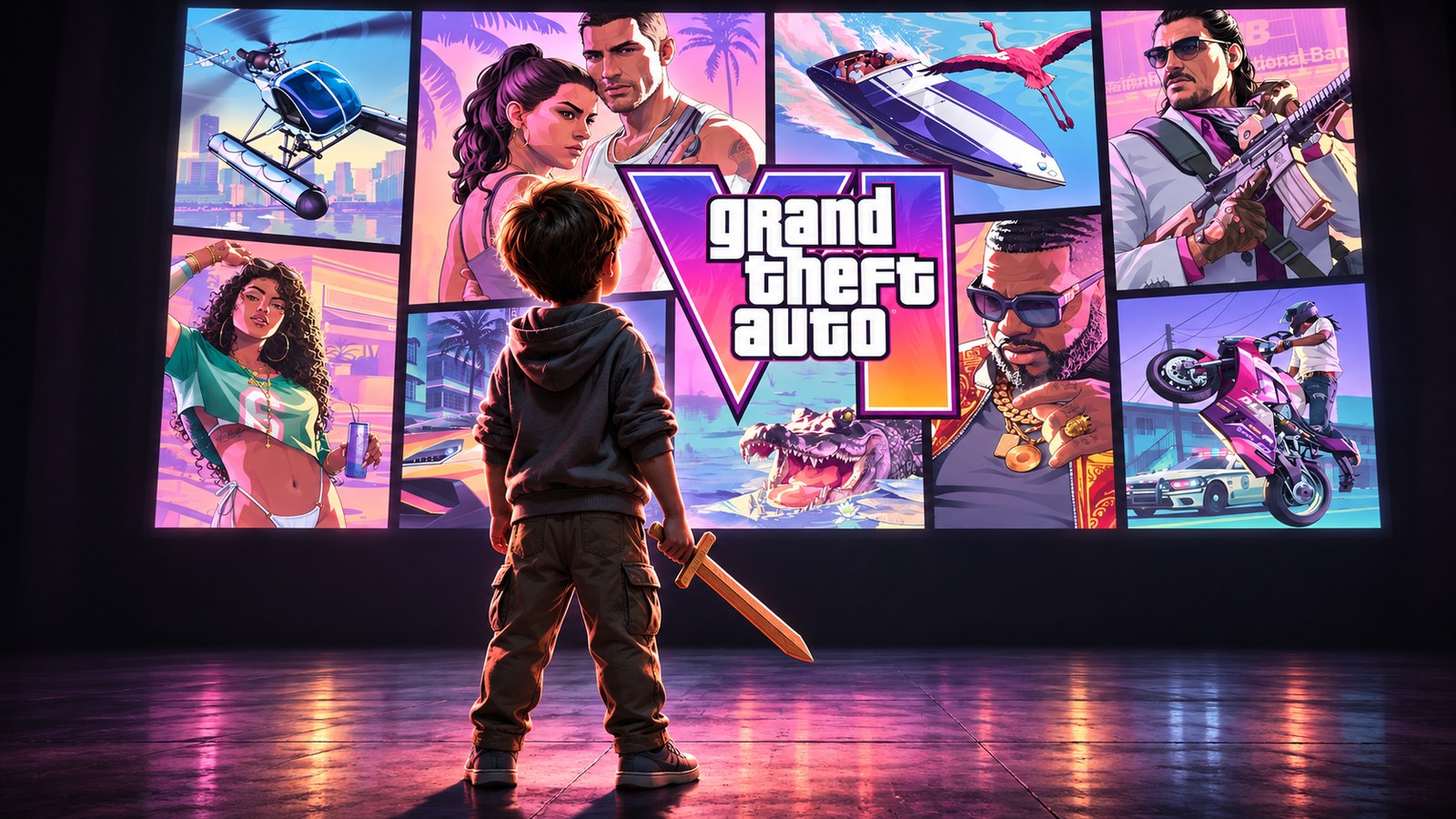
Il 19 novembre 2026, dopo due rinvii e oltre dieci anni dal capitolo precedente, è uscito Grand Theft Auto VI.
Grand theft auto è, nel diritto penale americano, il furto d’auto. Milioni di persone sono entrate nello stesso giorno in Leonida, il mondo del gioco: una Florida immaginaria in cui si ruba, si rapina, si fugge dalla polizia.
Una tensione
«Alla fine è solo un gioco». Il male che si compie sullo schermo è finto, e ciò che è finto non può essere colpevole. Inoltre «si è sempre giocato». I bambini hanno sempre fatto guardie e ladri, la guerra con i soldatini, i duelli con i bastoni: pistole e morte per eliminazione.
Eppure a molti resta una tensione emotiva che non si scioglie: la sensazione che qualcosa stia toccando un punto delicato di noi. È da questa tensione che nasce un dubbio. Se stai leggendo questo articolo è proprio così.
Il dibattito pubblico (oggi, mi pare, meno che in passato) si chiede se il gioco renda violenti, se servano limiti d’età più severi. Sono domande legittime, ma vengono poste prima di aver capito che cosa c’è davvero in gioco: domande di regolazione su un oggetto di cui non si è ancora interrogata la natura. Proviamo allora a fare un passo indietro, con lo strumento migliore che conosciamo per rispondere: la filosofia. Quella «scienza con la quale e senza la quale si vive tale e quale», come dice il detto; eppure chi lo pronuncia sta già facendo filosofia.
Che cos’è un gioco
Come accesso al problema iniziamo da qualcosa che ci appare piuttosto convincente. Così troviamo sulla nostra strada il filosofo Fink. Eugen Fink (1905-1975), allievo di Husserl e collega di Heidegger a Friburgo, ha dedicato al gioco due testi brevi e densi: Oase des Glücks («Oasi della felicità», 1957) e Spiel als Weltsymbol («Il gioco come simbolo del mondo», 1960). Il gioco non è un passatempo, ma uno dei fenomeni fondamentali dell’esistenza, accanto alla morte, al lavoro, al dominio e all’amore.
La vita ordinaria, osserva Fink, è sempre protesa verso uno scopo: lavoriamo per, studiamo per, risparmiamo per. Il gioco no. Non accade in vista di un fine ulteriore e ci restituisce il presente: è un’oasi nel deserto della ricerca della felicità.
Ma che mondo è quello in cui si gioca? Fink risponde con una formula precisa:
«In der sogenannten wirklichen Welt spielen wir, aber wir erspielen dabei einen Bereich, ein rätselhaftes Feld, das nicht nichts und doch nichts Wirkliches ist.»
Giochiamo nel cosiddetto mondo reale, ma giocando apriamo un campo enigmatico, che non è nulla eppure non è nulla di reale.
E. Fink, Oase des Glücks, 1957 (parafrasi).
Il mondo di gioco è dunque un mondo che non è mondo. Ha sempre un luogo reale: il cortile, il tavolo, la stanza. Ma dentro quel luogo si apre una dimensione immaginaria. Fink la chiama Schein, parola tedesca che significa insieme «apparenza», «parvenza» e «splendore». Non è un’illusione né un inganno: è un modo di essere, che il gioco produce.
Tre tratti di questo mondo-non-mondo contano per il nostro discorso.
- L’apparenza la produce chi gioca. Il bastone diventa spada perché è il bambino a farlo diventare tale. Per Fink giocare è «produzione magica di un mondo di gioco»: il bambino vive in due dimensioni insieme, e questo raddoppiamento, scrive Fink, appartiene all’essenza stessa del giocare.
- Il gioco è comunità. Giocare è giocare insieme, una piccola società con le sue regole, i suoi arbitri e i suoi rapporti di forza.
- La regola appartiene a chi gioca. «Die Spielregel ist kein Gesetz»: la regola vincola, ma non è una legge immutabile. Anche a partita iniziata la si può cambiare, se i compagni sono d’accordo.
In questo quadro il «come se» del gioco ha una sua solidità. La distanza tra il mondo di gioco e il mondo reale non è garantita da un regolamento esterno, ma dall’atto stesso di chi gioca.
Ogni gioco ha i suoi valori
Prima di guardare GTA VI conviene sgombrare il campo da un equivoco. Non è una novità che un gioco premi certi comportamenti. Ogni gioco ha un sistema di valori, rinforzato da premi: negli scacchi conta catturare, a nascondino conta non farsi trovare, a guardie e ladri il ladro vince se scappa. Anche il crimine immaginato è vecchio quanto il gioco.
La domanda giusta non è dunque se un gioco premi comportamenti che, se compiuti nel mondo reale, avrebbero una rilevanza morale, ma quanto il mondo di gioco sia separato dal nostro. Finché la distanza tra l’apparenza del gioco e il mondo della vita resta netta, i valori del gioco restano del gioco. Il punto è che questa distanza si sta consumando.
La distanza che si consuma
L’avvicinamento tra mondo di gioco e mondo reale non comincia con GTA VI. È una tendenza scritta nella natura del gioco tecnologico, e c’è stato un momento in cui è diventata visibile come in un esperimento: Second Life, lanciato nel 2003. Un mondo virtuale senza trama e senza obiettivi, costruito dai suoi abitanti, con una moneta convertibile in denaro vero. Linden Lab, la società che lo gestisce, voleva espressamente che non fosse scambiato per un videogioco. Il nome stesso dichiarava il «come se»: una vita seconda. Second Life esiste ancora, con circa 700.000 utenti attivi al mese secondo l’azienda, ma non è diventato il mondo parallelo che prometteva.
GTA VI arriva per un’altra strada, quella del gioco, e, senza bisogno di dichiararlo, fa della tendenza un dato di fatto. Confrontiamo i tre tratti di Fink.
- L’apparenza non la produce più chi gioca. Leonida è già tutta lì: le recensioni parlano di un mondo che sembra continuare a vivere anche senza di noi, senza tempi di caricamento, con passanti che reagiscono a ciò che vedono. Il bastone non deve più diventare spada: la spada è già resa in ogni dettaglio. L’apparenza è calcolata da altri e consegnata completa.
- La comunità è filtrata. Nelle modalità online il giocatore non è solo: gioca con altri, persone vere, e tra loro nasce una comunità con i suoi rapporti di forza, le sue alleanze, i suoi conflitti. Ma la relazione stessa si svolge dentro un contenitore privato, che la rende possibile e insieme la filtra e la orienta.
- La regola non appartiene più a chi gioca. Le regole e i premi sono fissati dal produttore e non si negoziano.
A questo si aggiunge un quarto elemento, ancora non del tutto dispiegato: il denaro vero. In GTA Online, la modalità multigiocatore del capitolo precedente, la valuta del gioco si compra anche con denaro reale. Qui il gioco mostra una parentela con il gioco d’azzardo: nel mondo di gioco esiste un casinò, dove le fiches si comprano con la valuta del gioco, che a sua volta si può comprare con denaro vero. Le vincite non si possono riconvertire in denaro reale, eppure in oltre cinquanta paesi le funzioni d’azzardo del casinò sono bloccate per rispettare le leggi locali, e quest’anno anche l’Australia le ha chiuse. Il giorno in cui il flusso diventasse reversibile, il confine sarebbe superato. Per GTA VI la modalità online non è ancora disponibile al lancio.
Il risultato è che lo scarto tra immagine e mondo si riduce. E quando si riduce, la pressione che il mondo di gioco esercita sul mondo della vita cresce: non sul comportamento immediato, ma sull’autocomprensione etica ed emotiva di chi gioca. Il mondo che non è mondo tende a presentarsi come un mondo pieno, e il «come se» che lo separava dal reale si consuma.
Che cosa si premia a Leonida
Se ogni gioco ha i suoi valori, che cosa premia questo? La risposta è più sottile di quanto si pensi. GTA VI non premia la violenza gratuita: il nuovo sistema di polizia punisce il caos e premia la discrezione, la fuga rapida, il colpo preparato bene. Un «profilo criminale» persistente misura quanto il giocatore sia professionale. Le rapine sono organizzate come una carriera, dai piccoli negozi ai furgoni portavalori, fino a gioiellerie e banche. In più punti la storia si ferma finché i protagonisti non hanno messo da parte la cifra necessaria.
Ciò che viene premiato, insomma, è il crimine competente: pianificato, efficiente, redditizio. In questo sistema di valori la proprietà e la libertà degli altri contano solo come un costo o un rischio, e la legge come un ostacolo da gestire.
Per equità va detto che il racconto può dire altro dalla meccanica. Qualche recensore legge sotto la superficie una riflessione amara: la strada dei soldi facili non porta alla felicità. Rockstar, del resto, ha sempre fatto satira dell’America. Ma la satira funziona solo se chi guarda resta a distanza da ciò che viene messo in ridicolo: ride del crimine perché non ci sta dentro. In un gioco, invece, il crimine non si guarda, si compie. E mentre il racconto si segue una volta, la meccanica dei premi si ripete per ore: chi gioca passa molto più tempo dentro il crimine ben fatto che davanti alla sua critica.
Il nome della tensione
Ora possiamo tornare alla tensione iniziale e darle un nome. Nel 1963, raccontando il processo ad Adolf Eichmann, Hannah Arendt coniò l’espressione «banalità del male». Non intendeva che il male fosse piccolo, ma che potesse nascere senza profondità e senza mostruosità: da un funzionario che esegue bene il proprio lavoro dentro un sistema di regole e incentivi, senza fermarsi a pensare.
Un videogioco non è un genocidio, e nessuno in Leonida è una vittima reale. L’accostamento non riguarda il danno, ma la forma dell’agire. Ciò che GTA VI ricompensa è proprio questa forma: il male eseguito come lavoro ben fatto, dentro un sistema di incentivi che qualcun altro ha deciso. Era questo, forse, il disagio che le due frasi rassicuranti non riuscivano a sciogliere.
Si dirà: però il male è finto, e questa preoccupazione è esagerata, perfino oscurantista. Qui aiuta Aristotele, che nell’Etica Nicomachea scrive:
οἷον οἰκοδομοῦντες οἰκοδόμοι γίνονται καὶ κιθαρίζοντες κιθαρισταί· οὕτω δὴ καὶ τὰ μὲν δίκαια πράττοντες δίκαιοι γινόμεθα
Costruendo si diventa costruttori e suonando la cetra citaristi; così anche compiendo azioni giuste diventiamo giusti.
Aristotele, Etica Nicomachea II 1, 1103a–b (parafrasi; cfr. trad. it. di C. Natali, Laterza).
Il carattere, per Aristotele, si forma ripetendo scelte. E nella Politica (VIII 5) aggiunge un’osservazione sorprendentemente attuale: abituarsi a provare piacere e dolore davanti alle somiglianze delle cose non è lontano dal provarli davanti alle cose stesse.
ὁ δ᾽ ἐν τοῖς ὁμοίοις ἐθισμὸς τοῦ λυπεῖσθαι καὶ χαίρειν ἐγγύς ἐστι τῷ πρὸς τὴν ἀλήθειαν τὸν αὐτὸν ἔχειν τρόπον
L’abitudine a provare dolore e piacere davanti alle somiglianze è vicina all’avere la stessa disposizione davanti alla verità.
Aristotele, Politica VIII 5, 1340a23–25 (parafrasi; cfr. trad. it. di R. Laurenti, Laterza).
Nel gioco l’oggetto è finto, ma la scelta è vera: sono io a decidere di rapinare il negozio. Il «come se» ha sempre neutralizzato l’oggetto, mai la decisione. Finché l’apparenza la produceva chi giocava, la distanza era sua e la governava lui. Quando l’apparenza è calcolata da altri, la distanza e i valori li amministra qualcun altro.
La domanda giusta, allora, non è «il gioco rende violenti?». È un’altra: che carattere si forma quando una scelta vera si esercita per ore su somiglianze sempre più vicine al mondo, dentro un sistema che associa il piacere della ricompensa al crimine ben fatto?
Con il consumarsi del «come se», la forma ludica, da secoli neutralizzata, è un cavallo di Troia per qualcosa che ha uno statuto non più neutro.
Oltre il gioco
La stessa struttura si ripete nelle intelligenze artificiali con le quali ci stiamo abituando a conversare ogni giorno, ripetutamente. Anche loro sono plasmate da premi: vengono addestrate rinforzando le risposte giudicate migliori. E anche loro ci consegnano un’apparenza già compiuta, quella di un discorso, che usiamo per decidere e per agire. L’ontologia di questi videogiochi avanzati condivide, a un livello inferiore, l’ontologia del logos calcolato dei grandi modelli linguistici (LLM), e come tale va affrontata con strumenti teorici adeguati. L’incorporazione dei fini e l’erosione della radice etico-emotiva sono i piani su cui vigilare.
In termini non tecnici: tre prime domande per chi governa.
- Chi vede. Il gioco profila già il giocatore al proprio interno, per esempio con il profilo criminale. Che uso si faccia dei dati di comportamento, dentro e fuori dal gioco, è una domanda che merita trasparenza.
- Dove passa il confine col denaro. Quando la valuta di gioco si compra con denaro vero, la parentela con l’azzardo smette di essere una metafora.
- Che cosa regolare. Oggi la regolazione guarda soprattutto al contenuto rappresentato: quanta violenza, per quale età. Quasi mai guarda alla struttura dei premi, cioè a che cosa un mondo calcolato rende conveniente fare. I fini e i valori che un gioco premia hanno dunque una rilevanza pubblica: chiedono trasparenza e discussione, in un mondo che vuole sentirsi libero e democratico. Con distanze così consumate, la comprensione etica e morale è sotto pressione. Il gioco non è solo un gioco: ha una componente di addestramento moralmente rilevante, e questo deve riguardarci.
La tensione da cui siamo partiti non chiedeva di vietare un gioco, né di assolverlo. Chiedeva di capire che cosa accade quando il mondo che non è mondo si avvicina tanto al nostro da non lasciarci più il compito, e la libertà, di produrre da soli la distanza.
È solo un accenno, che richiede un’analisi filosofica adeguata. Spero sia bastato a mostrare che si tratta di domande importanti, e che vanno poste nel modo giusto: perché in un gioco può essere in gioco qualcosa di più di un gioco.
Riferimenti: E. Fink, Oase des Glücks, Alber 1957, e Spiel als Weltsymbol, Kohlhammer 1960 · H. Arendt, Eichmann in Jerusalem, 1963 (trad. it. La banalità del male, Feltrinelli) · Aristotele, Etica Nicomachea II 1; Politica VIII 5 · Recensioni di GTA VI: The Games Machine ↗, Multiplayer.it ↗, SpazioGames ↗ · Casinò di GTA Online: PC Gamer ↗ · Second Life: 80.lv ↗. Le interpretazioni sono mie.
On 19 November 2026, after two delays and more than ten years after the previous instalment, Grand Theft Auto VI was released.
Grand theft auto is, in American criminal law, car theft. Millions of people entered Leonida on the same day, the world of the game: an imaginary Florida where you steal, rob and run from the police.
A tension
“In the end it’s just a game”. The evil done on screen is fake, and what is fake cannot be guilty. Besides, “we have always played”. Children have always played cops and robbers, war with toy soldiers, duels with sticks: pistols, and death by elimination.
And yet many are left with an emotional tension that does not go away: the feeling that something is touching a sensitive point in us. It is from this tension that a doubt arises. If you are reading this, chances are you feel it too.
Public debate (less than in the past today, it seems to me) asks whether games make people violent, whether stricter age limits are needed. These are legitimate questions, but they are asked before understanding what is really at stake: questions of regulation about an object whose nature has not yet been examined. Let us then take a step back, with the best tool we know for answering: philosophy. As an Italian saying goes, it is “the science with which and without which you live just the same”; and yet whoever says so is already doing philosophy.
What is a game
As a way into the problem, let us start from something that seems rather convincing to us. So we come across the philosopher Fink. Eugen Fink (1905–1975), a student of Husserl and a colleague of Heidegger in Freiburg, devoted two short, dense texts to play: Oase des Glücks (“Oasis of Happiness”, 1957) and Spiel als Weltsymbol (“Play as Symbol of the World”, 1960). Play is not a pastime, but one of the fundamental phenomena of existence, alongside death, work, domination and love.
Ordinary life, Fink observes, always strains towards a purpose: we work for, study for, save for. Play does not. It does not happen for the sake of a further end and gives us back the present: it is an oasis in the desert of the pursuit of happiness.
But what kind of world is the one in which we play? Fink answers with a precise formula:
«In der sogenannten wirklichen Welt spielen wir, aber wir erspielen dabei einen Bereich, ein rätselhaftes Feld, das nicht nichts und doch nichts Wirkliches ist.»
We play in the so-called real world, but in playing we open up a realm, an enigmatic field that is not nothing and yet is nothing real.
E. Fink, Oase des Glücks, 1957 (paraphrase).
The play-world is thus a world that is not a world. It always has a real place: the courtyard, the table, the room. But within that place an imaginary dimension opens up. Fink calls it Schein, a German word meaning “appearance”, “semblance” and “shine” all at once. It is neither an illusion nor a deception: it is a way of being, which play produces.
Three features of this world-that-is-not-a-world matter for our argument.
- Appearance is produced by the player. The stick becomes a sword because the child makes it one. For Fink, playing is “the magical production of a play-world”: the child lives in two dimensions at once, and this doubling, Fink writes, belongs to the very essence of playing.
- Play is community. Playing is playing together, a small society with its own rules, its referees and its power relations.
- The rule belongs to the players. “Die Spielregel ist kein Gesetz”: the rule binds, but it is not an unchangeable law. Even in the middle of a game it can be changed, if one’s fellow players agree.
In this picture the “as if” of play has a solidity of its own. The distance between the play-world and the real world is guaranteed not by an external regulation, but by the very act of the player.
Every game has its values
Before looking at GTA VI, a misunderstanding needs clearing away. It is nothing new for a game to reward certain behaviours. Every game has a system of values, reinforced by rewards: in chess what counts is capturing, in hide-and-seek not being found, in cops and robbers the robber wins if he gets away. Imagined crime is as old as play itself.
The right question, then, is not whether a game rewards behaviours that, if carried out in the real world, would be morally relevant, but how far the world of the game is separated from ours. As long as the distance between the appearance of the game and the lifeworld remains clear, the values of the game remain the game’s. The point is that this distance is wearing away.
The distance wearing away
The convergence of the game world and the real world does not begin with GTA VI. It is a tendency written into the nature of technological play, and there was a moment when it became visible as in an experiment: Second Life, launched in 2003. A virtual world with no plot and no goals, built by its inhabitants, with a currency convertible into real money. Linden Lab, the company that runs it, expressly wanted it not to be mistaken for a video game. The name itself declared the “as if”: a second life. Second Life still exists, with around 700,000 monthly active users according to the company, but it has not become the parallel world it promised.
GTA VI arrives by another road, that of the game, and, without needing to declare it, turns the tendency into a fact. Let us compare Fink’s three features.
- Appearance is no longer produced by the player. Leonida is already all there: reviews speak of a world that seems to go on living even without us, with no loading times, with passers-by who react to what they see. The stick no longer has to become a sword: the sword is already rendered in every detail. The appearance is calculated by others and delivered complete.
- Community is filtered. In online modes the player is not alone: they play with others, real people, and a community forms among them, with its power relations, its alliances, its conflicts. But the relationship itself takes place inside a private container, which makes it possible and at the same time filters and steers it.
- The rule no longer belongs to the players. The rules and the rewards are set by the producer and cannot be negotiated.
To this a fourth element is added, not yet fully deployed: real money. In GTA Online, the multiplayer mode of the previous instalment, the game’s currency can also be bought with real money. Here the game shows a kinship with gambling: the game world has a casino, where chips are bought with the game’s currency, which in turn can be bought with real money. Winnings cannot be converted back into real money, yet in more than fifty countries the casino’s gambling features are blocked to comply with local laws, and this year Australia closed them too. The day the flow became reversible, the line would be crossed. For GTA VI, the online mode is not yet available at launch.
The result is that the gap between image and world narrows. And as it narrows, the pressure the game world exerts on the lifeworld grows: not on immediate behaviour, but on the ethical and emotional self-understanding of those who play. The world that is not a world tends to present itself as a full world, and the “as if” that separated it from the real is wearing away.
What is rewarded in Leonida
If every game has its values, what does this one reward? The answer is subtler than one might think. GTA VI does not reward gratuitous violence: the new police system punishes chaos and rewards discretion, the quick getaway, the well-prepared job. A persistent “criminal profile” measures how professional the player is. Robberies are organised like a career, from small shops to cash-in-transit vans, up to jewellers and banks. At several points the story stops until the protagonists have put aside the necessary sum.
What is rewarded, in short, is competent crime: planned, efficient, profitable. In this system of values, other people’s property and freedom count only as a cost or a risk, and the law as an obstacle to be managed.
In fairness, the story can say something other than the mechanics. Some reviewers read a bitter reflection beneath the surface: the road of easy money does not lead to happiness. Rockstar, after all, has always satirised America. But satire works only if the viewer stays at a distance from what is being ridiculed: one laughs at crime because one is not inside it. In a game, however, crime is not watched, it is committed. And while the story is followed once, the mechanics of reward repeat for hours: the player spends far more time inside well-executed crime than in front of its critique.
The name of the tension
Now we can return to the initial tension and give it a name. In 1963, reporting on the trial of Adolf Eichmann, Hannah Arendt coined the expression “banality of evil”. She did not mean that evil was small, but that it could arise without depth and without monstrousness: from an official who does his job well within a system of rules and incentives, without stopping to think.
A video game is not a genocide, and no one in Leonida is a real victim. The comparison concerns not the harm but the form of action. What GTA VI rewards is precisely this form: evil carried out as a job well done, within a system of incentives that someone else has decided. This, perhaps, was the unease that the two reassuring phrases could not dispel.
It will be said: but the evil is fake, and this concern is exaggerated, even obscurantist. Here Aristotle helps; in the Nicomachean Ethics he writes:
οἷον οἰκοδομοῦντες οἰκοδόμοι γίνονται καὶ κιθαρίζοντες κιθαρισταί· οὕτω δὴ καὶ τὰ μὲν δίκαια πράττοντες δίκαιοι γινόμεθα
People become builders by building and lyre-players by playing the lyre; so too we become just by doing just acts.
Aristotle, Nicomachean Ethics II 1, 1103a–b (paraphrase; cf. the translation by W. D. Ross).
Character, for Aristotle, is formed by repeating choices. And in the Politics (VIII 5) he adds a surprisingly topical observation: becoming used to feeling pleasure and pain before likenesses of things is not far from feeling them before the things themselves.
ὁ δ᾽ ἐν τοῖς ὁμοίοις ἐθισμὸς τοῦ λυπεῖσθαι καὶ χαίρειν ἐγγύς ἐστι τῷ πρὸς τὴν ἀλήθειαν τὸν αὐτὸν ἔχειν τρόπον
The habit of feeling pain and pleasure at likenesses is close to having the same disposition towards the truth.
Aristotle, Politics VIII 5, 1340a23–25 (paraphrase; cf. the translation by B. Jowett).
In the game the object is fake, but the choice is real: I am the one who decides to rob the shop. The “as if” has always neutralised the object, never the decision. As long as the appearance was produced by the player, the distance was theirs and they governed it. When the appearance is calculated by others, the distance and the values are administered by someone else.
The right question, then, is not “do games make people violent?”. It is another: what character is formed when a real choice is exercised for hours on likenesses ever closer to the world, within a system that links the pleasure of reward to well-executed crime?
As the “as if” wears away, the form of play, neutralised for centuries, becomes a Trojan horse for something whose status is no longer neutral.
Beyond the game
The same structure recurs in the artificial intelligences we are getting used to talking with every day, repeatedly. They too are shaped by rewards: they are trained by reinforcing the answers judged best. And they too deliver an appearance already complete, that of a discourse, which we use to decide and to act. The ontology of these advanced video games shares, at a lower level, the ontology of the Calculated Logos of large language models (LLMs), and as such must be addressed with adequate theoretical tools. The incorporation of ends and the erosion of the ethical-emotional root are the levels to watch over.
In plain terms: three first questions for those who govern.
- Who sees. The game already profiles the player internally, for instance with the criminal profile. What use is made of behavioural data, inside and outside the game, is a question that deserves transparency.
- Where the line with money runs. When game currency is bought with real money, the kinship with gambling stops being a metaphor.
- What to regulate. Today regulation looks mostly at the content represented: how much violence, for what age. It almost never looks at the structure of rewards, that is, at what a calculated world makes it convenient to do. The ends and values a game rewards therefore have public relevance: they call for transparency and discussion, in a world that wants to feel free and democratic. With distances so worn away, ethical and moral understanding is under pressure. The game is not just a game: it has a morally relevant training component, and this must concern us.
The tension we started from did not ask us to ban a game, nor to absolve it. It asked us to understand what happens when the world that is not a world comes so close to ours that it no longer leaves us the task, and the freedom, of producing the distance ourselves.
This is only a sketch, which calls for an adequate philosophical analysis. I hope it has been enough to show that these are important questions, and that they must be asked in the right way: because in a game, something more than a game may be at play.
References: E. Fink, Oase des Glücks, Alber 1957, and Spiel als Weltsymbol, Kohlhammer 1960 · H. Arendt, Eichmann in Jerusalem, 1963 · Aristotle, Nicomachean Ethics II 1; Politics VIII 5 · Reviews of GTA VI (in Italian): The Games Machine ↗, Multiplayer.it ↗, SpazioGames ↗ · GTA Online casino: PC Gamer ↗ · Second Life: 80.lv ↗. The interpretations are my own.